
Welcome, cricket fans! Understanding the intricate ballet of a cricket field is crucial to appreciating the tactical depth of the game. It’s not just about stopping a boundary; it’s about predicting the batsman’s next move and outmaneuvering the entire team.
Let’s dive into the fascinating world of cricket fielding positions, exploring their roles, required skills, and how they evolve across formats and bowling styles.
A cricket field is a complex grid of positions, each with a specific name and purpose. Let’s explore some key roles:
The Slip Cordon (First Slip, Second Slip, Third Slip)
Role: Catching edges off the batsman’s bat. They form a defensive semicircle behind the wicketkeeper.
Why they stand there: This is the most common area where edge catches go, especially for fast bowlers and early in the innings. They need to react in milliseconds.
Skills: Exceptional reflexes, concentration, soft hands to absorb the impact of the ball, and superb catching ability.
The Wicketkeeper
Role: The most active fielder. They gather balls thrown from the field, attempt stumpings, and are a crucial part of the dynamic between the bowler and the captain.
Why they stand there: To catch any balls missed by the batsman and affect run-outs or stumpings.
Skills: Incredible athletic agility, deep knowledge of the game, precise footwork, lightning-fast reflexes, and robust communication skills.
Point & Gully
Role: Fielding close to the off-side to stop quick runs and catch slices or cuts.
Why they stand there: Batsmen frequently hit balls in this area, particularly off the back foot against faster bowling.
Skills: Fast reflexes, acrobatic diving ability, a strong throwing arm, and the concentration to anticipate a ball being hit towards them.
Mid-off & Mid-on
Role: Key positions for saving runs and initiating quick returns to the bowler.
Why they stand there: To prevent the batsman from playing straight drives for quick runs. Mid-on is on the leg side, mid-off on the off side.
Skills: Powerful throwing arm, agility to cover ground quickly, good game sense to cut off angles, and the ability to anticipate a quick single.
Midwicket & Square Leg
Role: Patrolling the leg-side boundaries and intermediate areas to prevent runs and take catches from pull shots or sweep shots.
Why they stand there: Batsmen often target the leg side for boundaries, especially when playing across the line.
Skills: Excellent stamina and speed to cover large areas, powerful throwing from the boundary, and strong catching skills for high balls.
Fine Leg
Role: A deep leg-side position to stop balls hit behind the batsman on the leg side, often off pull shots or glance shots.
Why they stand there: This position is critical for preventing boundary runs when the batsman looks to flick the ball fine.
Skills: Speed and agility to chase down balls hitting the boundary rope, a rocket of a throwing arm, and the ability to judge the ball’s trajectory perfectly.
Do Positions Change with Bowling Type?
Absolutely. A dynamic captain adjusts the field based on the bowler’s style and the batsman’s perceived weaknesses.
- Fast Bowlers: The slip cordon is typically deeper and larger (sometimes 4 or 5 slips). Outfield fielders might be closer to the boundary to cut off fast runs. More fielders on the off-side are common as the ball is expected to leave the batsman.
- Medium Bowlers: The slips may be fewer (1 or 2) and slightly closer. Outfield fielders might be more evenly distributed on both off and leg sides, adapting to the batsman’s strokes.
- Slow (Spin) Bowlers: Fielders are brought much closer to the bat. You’ll see a “short leg” and a “silly point” on the off-side to capitalise on inside edges or bat-pad catches. Slips are fewer, perhaps just one, but placed closer. Mid-off and Mid-on might be deep to prevent lofted boundaries.
Test vs. T20: A Tale of Formats
The game’s shortest and longest formats demand different strategic approaches to fielding:
Test Cricket: A game of patience. Captains take a “cat and mouse” approach. Field placements are aggressive, aimed at taking wickets. The slip cordon is packed, and close-in fielders are placed with surgical precision to exploit small cracks in the batsman’s technique. There’s less emphasis on restricting boundaries compared to finding a wicket.
T20 Cricket: A high-octane battle where restricting boundaries is paramount. Captains rely heavily on boundary-saving positions like deep midwicket, long-on, and deep square leg. “Death bowling” (the final overs) requires fielders to be deep on the boundary and extremely fast. Close-in fielders are almost non-existent as the game’s dynamic focuses on runs rather than edges.
A Tactical Masterclass
This intricate dance of fielders isn’t just about positioning; it’s a window into the captain’s mind. Each move is a tactical calculation, a constant adjustment to the conditions, the bowler, and the batsman’s state of mind. Next time you watch a match, pay attention not just to the action but to the strategic repositioning. It’s the silent battle that often decides the fate of a game.
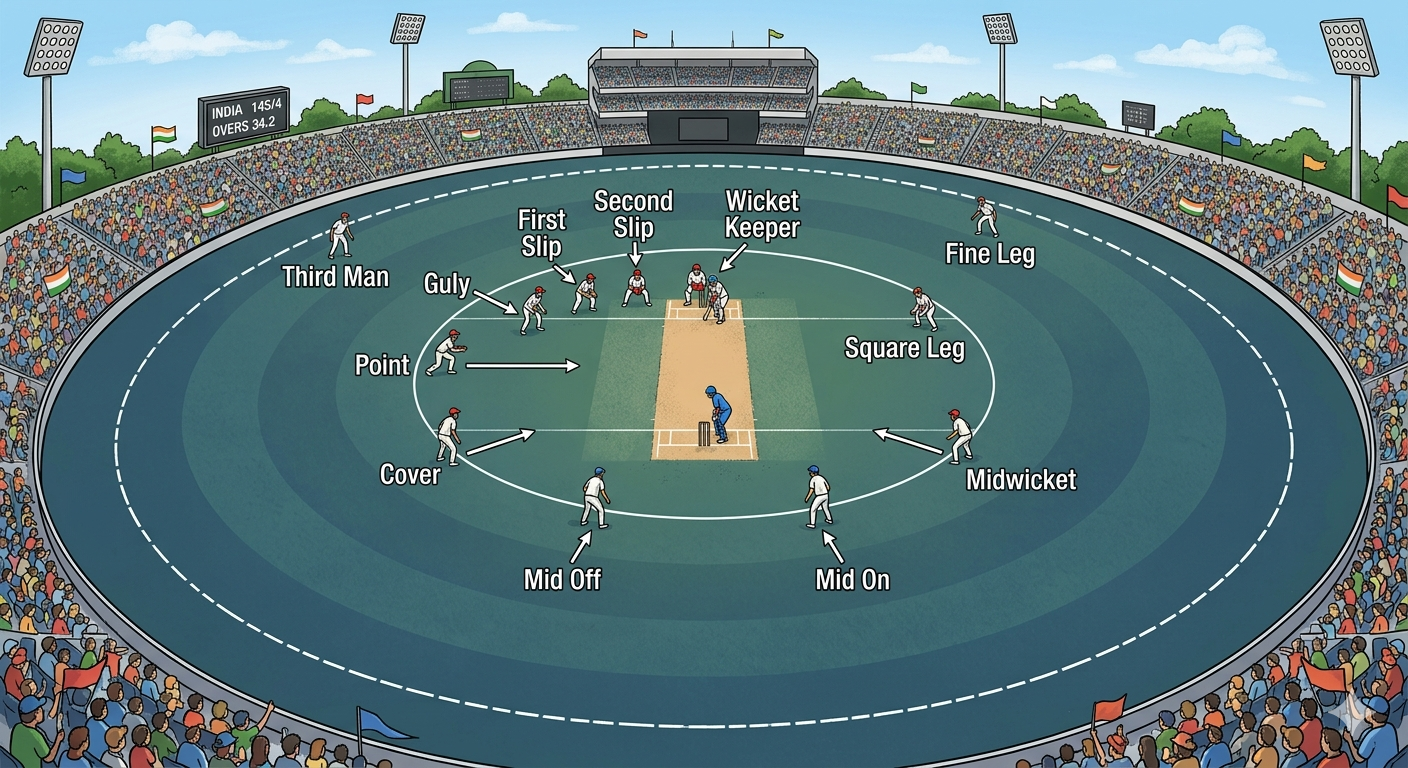
A Visual Guide to the Cricket Field
To help you visualise these positions and concepts, we’ve included a tactical drawing of a standard cricket field with many of the key positions labelled.
Slips: (labeled as Slip Cordon) – Positioning behind the keeper on the off-side for edges.
Gully: Just wide of the slips.
Point: Directly parallel to the batsman on the off-side.
Cover: Wider off-side position.
Mid-off/Mid-on: Positioned directly straight.
Midwicket/Square Leg: Positions on the leg-side for leg glances and pull shots.
Fine Leg: Deep on the leg-side behind the batsman.


Leave a Reply