
The Solitude of the Road
The car sat on the forecourt, silver and humdrum under the Cornish drizzle. It looked inviting, if a little melancholic, like a stray dog hoping for a home. I bought it for a few hundred pounds; the price was almost too good. But the moment I pulled onto the A30, the air changed.
The A30—usually a busy, noisy, crowded artery of travel—fell suddenly empty. Outside my window, the world turned grey and silent. There was no wind, no noise. I saw other cars racing by, but I didn’t know them; they were formless shapes, empty and ghost-like. The roar of the wind was gone, and the hum of the tyres suddenly cut out. I felt like I was underwater.
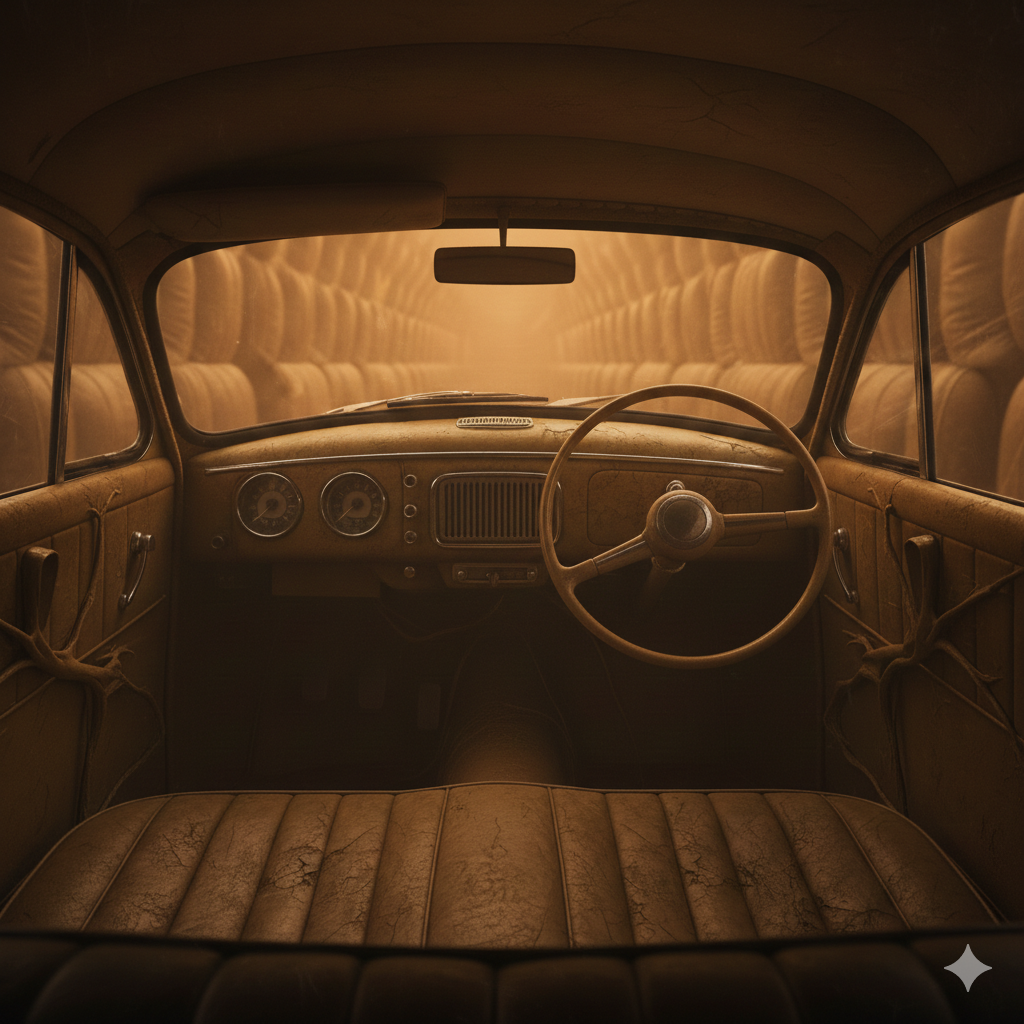
The heater blew cold—colder than the February frost—and a silence settled over the cabin that felt miles deep. I looked in the mirror, but I couldn’t see the traffic behind me, only a grey, shifting mist. I was the last soul left in England. The loneliness pressed against my ribs until I couldn’t breathe. I just wanted to hear a human sound.
“Hello?” I whispered.
The car whispered back. The interior lights glowed with a sickly amber hue, the doors dead-bolted, and I felt myself fading into the seat. I reached for the door handle, but my hand met only more stitched hide. There was no glass, no metal. Just miles and miles of tan leather lit by a dim, sourceless glow. I wasn’t in a car any more; I was inside the “idea” of a car. I woke up in another dimension, a void of endless leather with no exit signs.
The New Owners
Nobody knew what happened to the old owner. Nobody really cared, especially the used car salesman. He just wanted his bonus. He saw a family that looked gullible and moved in for the kill.
“Come and sit in. Feel that leather,” he urged. When asked why it was so cheap, he simply shrugged. “Special offer.”
They bought it. Dad looked at the car and asked, “What do we call it?”
“Rosie,” the family replied in unison.
“You’re now part of our family, Rosie,” Dad said, patting the bonnet. “I promise to wash you at least once a year—mind you, I don’t wash much more than that myself!”
They took her on trips to the beach. They talked to her. They treated her as a confidante. One day, Dad told a particularly groan-worthy joke. “I’ll tell her the joke,” he laughed, “and if she starts, she’s laughing with her engine. If she doesn’t, well, it was a bad joke.”
Rosie refused to start. The family was delighted, giving her a hug for her “opinion.” When he tried a better joke, the radio dials twitched, the engine gave a contented chuckle, and she roared to life. They got into the habit of saying “thanks” after every safe journey home.
The Gear Change
When you change gears in a car, you usually hear the initial rumble as you draw on new power. Rosie began to roar all the time, but it was the roar of something that knew it was loved. She even developed a sense of mischief; as Dad would arrive home, she would occasionally spray him with her windscreen washers just for a laugh.
The metal, once so cold and hard, had truly thawed. Now, her MPH was on high and she dreamt about the miles she covered, no longer a lonely vessel, but a living heart.
The Youngest Daughter
The youngest daughter, often a dreamer, sat in the car one day. She wanted to talk to the car the same way she chatted with snails in the garden. She wasn’t lonely; she was friendly.
“Hello, Rosie,” she said softly.
Suddenly, the cabin filled with a brilliant, warm light and a chorus of mechanical hums. She didn’t disappear. Instead, she looked out the window in shock.
Standing on the pavement were seven people, looking utterly confused. One man looked like he had stepped straight out of the 80s, clutching a road map dated 1989. A woman stood nearby, staring at a modern smartphone in a passerby’s hand while holding a plastic “brick” phone. They were pale, smelling of old leather and ozone, but they were home. The car had finally felt heard enough to let go of everyone it had ever taken.
A Drive to Par Beach
The driveway was no longer a quiet terraced strip. It was a scene of beautiful, chaotic confusion.
The man from 1989 was sat on the kerb, weeping as he watched a modern electric car glide silently past. The woman with the “brick” phone was trying to explain to Abigail that she had only been “popping to the shops for some milk” when the world turned to leather.
Rosie sat in the middle of it all, her silver paint gleaming. She looked like any other Morris Minor, but there was a new lightness to her. The “void” that had once chilled the air was gone, replaced by the faint, comforting scent of Mia’s spilled blackcurrant squash and the warmth of a family that actually cared.
Anna brought out a tray of tea for the seven “travellers,” serving them in the mismatched mugs they’d kept for years. “You’ve been gone a long time,” she said softly to the first driver, the one who had bought Rosie for a few hundred pounds.
He took a sip of the hot tea, his hands still shaking. “It felt like a thousand years of silence,” he whispered. “Until I heard a little girl say ‘Hello’—and the silence finally broke.”
The family didn’t sell Rosie. They knew she was dangerous when lonely, so they made sure she never was again. Every Sunday, they’d pile in, Storm the dog tucked in the back, and they’d talk to her the whole way to the coast. They told her about their day, their dreams, and their worst jokes.
And every time they reached the clifftop, Mia would pat the dashboard and whisper, “Thanks for the lift, Rosie.”
The car would hum back—a low, satisfied purr that sounded exactly like a cat sitting by a warm fire.
The Final “Hello”
Mia leaned forward from the back seat, her small hand patting the warm, tan leather of the dashboard. The car felt different today; it felt like it was holding its breath.
“Hello, Rosie,” she whispered, not because she was lonely, but because she was happy.
The effect was instantaneous. The radio didn’t hiss with static; it chirped a joyful, melodic chord. The headlights didn’t just turn on—they flicked once, then twice, a deliberate and cheeky wink at the world.
Rosie wasn’t a trap any more. She was a sanctuary. And as the sun began to peek through the clouds, the car gave one final, contented squirt of its windscreen washers—right at the back of Dad’s head.
Mia leaned forward and patted the dashboard. The headlights flicked—a deliberate, cheeky wink. The void was gone.


Leave a Reply