The Great Migration (The Atlantic Crossing)
The first sign wasn’t the birds or the silence, but the water. One morning, Anna came back from her swim, her teeth chattering more than usual, complaining the lake was “down a good foot.” Then, the ground began to hum—not the sharp vibration of a T-Rex, nor the rhythmic thrum of a Sauropod herd, but a low, continuous rumble that seemed to emanate from the very earth beneath our huts.
Rosie, our animal healer and the village’s unofficial elder, called a council. “The Grandest of the Long-Necks are stirring,” she announced, her voice grave. “It’s been fifty years, almost to the day. The Atlantic Crossing is upon us.”
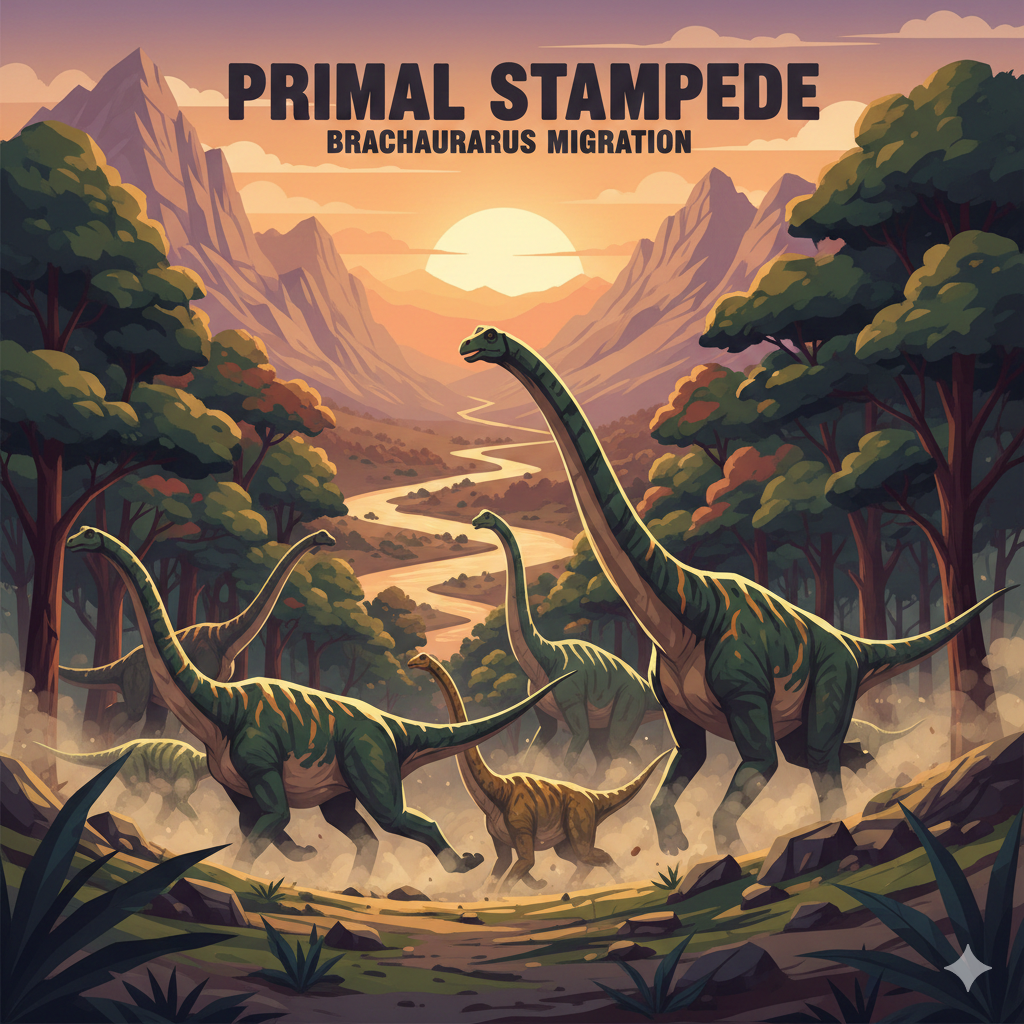
Whispers rippled through the gathering. Everyone knew what that meant. Every half-century, the truly colossal herds—beasts so immense even Rachel looked like a calf—would migrate from the deep south, through our valley, and to the ancestral nesting grounds by the sea. And their traditional path, etched by generations of gargantuan feet, led directly through the heart of our village.
“We must build barricades!” cried Thomas, usually the most laid-back of the men, but now his face was etched with fear. “Spikes! A diversion!”
“Foolishness!” Rosie snapped, slamming her staff against the ground. “You try to divert a living mountain, you’ll just make it angry. And then our huts won’t be merely trampled; they’ll be scattered kindling!”
That night, the debate continued in our hut. Anna was pacing, worry creasing her brow. “We can’t just let them walk through. Our homes, our supplies… even if they’re careful, one misplaced foot could destroy everything.”
“But they’re not trying to hurt us,” Abi piped up, ever the dinosaur advocate. “Remember the baby Brachiosaurus? And Rachel with Mia?”
“Abi has a point,” I said, looking from Anna to the girls. “We’ve learned to live with them, not against them. Maybe… maybe we can guide them.”
The idea was outlandish, even for our village. But with Rosie’s support, and after much heated debate, our family’s proposal was put to the test. Instead of barricades, we would build a “Great Guiding”—a wide, smoke-lined highway through the centre of the village. For days, every able-bodied villager moved their wood-burners, their cooking fires, and anything that could produce smoke, lining the route. We emptied huts, stacked supplies high, and even moved the MacDonald’s barbecue pit into a safe zone.
“It’s a gamble,” Anna admitted, watching a line of smoke rise from what used to be our communal dining area. “But it’s better than becoming prehistoric roadkill.”
The air grew heavy, the constant hum of the ground growing stronger. Storm was restless, constantly whining, not barking, as if sensing the sheer scale of what was coming. Midnight, for once, was nowhere to be seen.
Then, the sky turned bruised, and the first fat drops of rain splattered onto the leaves. A true Atlantic gale was brewing, the kind that had brought Storm to our door. Just as the wind began to howl, pushing the smoke from our guiding fires sideways, the first of them appeared at the valley’s entrance.
They weren’t just big; they were immense. Their heads were lost in the low-hanging clouds, their skin like ancient, moving rock formations. The ground trembled with each step, a deep, resonant bass note that vibrated through your bones. The leading beasts hesitated, confused by the shifting smoke and the howling storm.
“Now!” I yelled over the wind. “Light the flares! Sound the calls!”
Abi and Mia, fearless in the face of these giants, grabbed specially prepared torches. Guided by the unique calls Storm was making—a series of low, guiding whines and barks, almost conversational—they ran ahead, waving the flames along the designated path. The combined scent of a hundred wood-fires, now intensified by the storm, created a swirling, fiery tunnel.
The lead Brachiosaurus paused, its colossal head dipping. It seemed to assess the path, the smoke, and the tiny, flaming creatures waving below. Then, with a slow, deliberate step, it moved. One by one, the grand herd followed, a river of ancient life flowing through our village. The storm raged, rain lashed down, and the wind screamed, but the guiding fires, fed by every man, woman, and child, held fast.
We watched, awestruck and terrified, as the giants passed. Huts swayed, mud splattered, and the ground was a constant tremor. But not a single hut was crushed. The beasts seemed to understand, their immense feet falling deliberately between our precious homes. It was a dance between giants and ants, played out in the heart of a prehistoric storm.
By dawn, the last of the Grandest of the Long-Necks had vanished into the Atlantic mist, leaving behind only colossal footprints and the lingering scent of damp earth. The storm had passed, leaving a rainbow arching over our valley.
As we surveyed the mud and damp, a cheer erupted. Where the largest of the Brachiosaurus had paused, a new spring of crystal-clear water bubbled up from the ground, sparkling with a faint, metallic sheen. Rosie knelt, tasting the water, then scooping up a handful of the soil. “Tin!” she cried. “A rich vein of Cornish tin! A gift from the Ancients!”
That night, the village celebrated. Not just for surviving, but for triumphing with cooperation. Donald and Mac fired up their barbecue, and even I, a staunch vegetarian, found myself laughing and sharing a tale or two. As I watched Abi and Mia dance around the fires, holding hands with their friends, I knew our family—our unique, dinosaur-friendly, shorts-wearing, pizza-loving family—had found our true place in this wild, wonderful, prehistoric Cornwall. We didn’t just hang out with the dinosaurs; we lived as one with them.


Leave a Reply