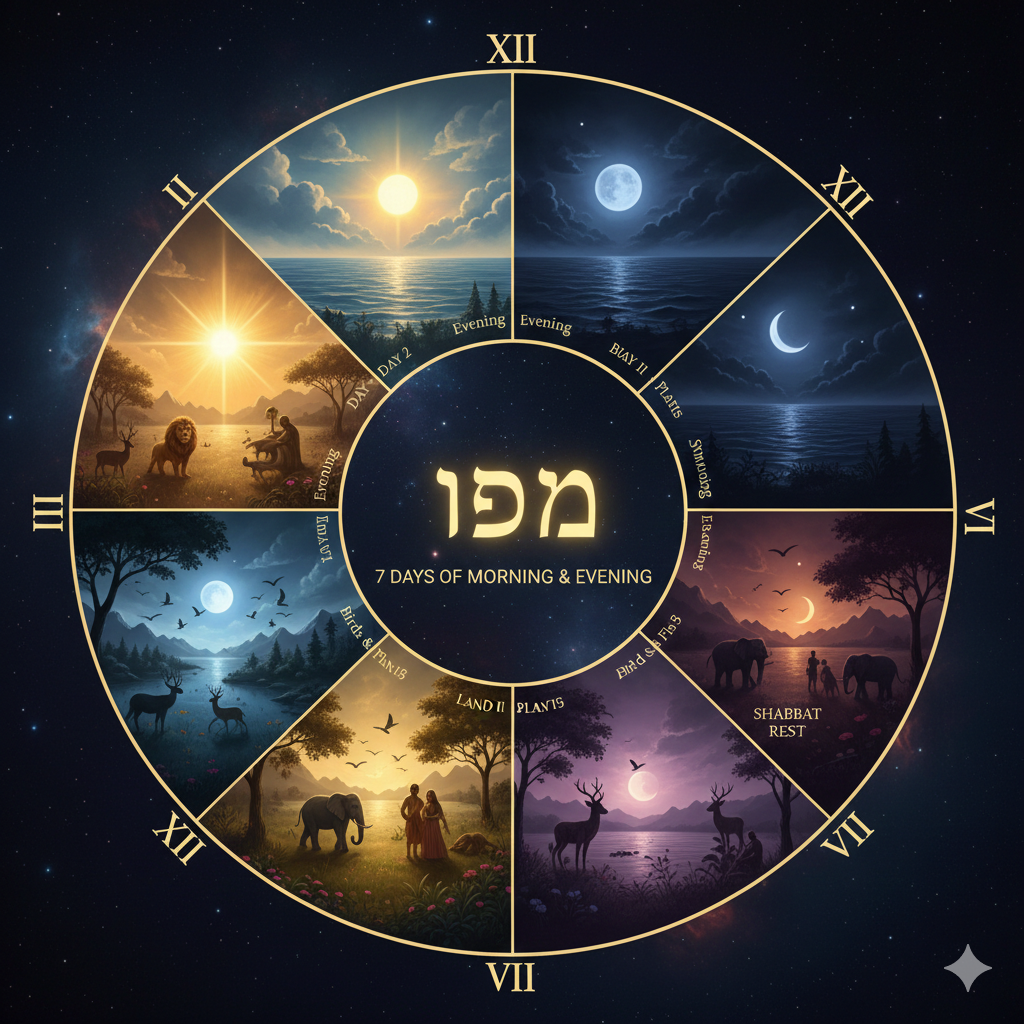

In Biblical Hebrew, the word for “day” is yom ($יום$). This single word is at the heart of the debate between different creationist and theological viewpoints.
Here are the three primary arguments regarding the “days” of Genesis 1:
1. The Literal 24-Hour View (Solar Day)
This is the standard Young Earth Creationist position. The argument is that whenever yom is used in the Old Testament with certain modifiers, it always means a standard day.
- Numerical Modifiers: When “day” is used with a number (e.g., “first day,” “second day”), it almost exclusively refers to a 24-hour period in Hebrew literature.
- The “Evening and Morning” Clause: The text repeats the phrase “And there was evening, and there was morning.” Proponents argue this specifically defines the boundaries of a literal solar day.
- The Fourth Commandment: In Exodus 20:11, the command to keep the Sabbath is explicitly linked to the six days of Creation: “For in six days the Lord made the heavens and the earth… but he rested on the seventh day.”
2. The “Age-Day” View (Long Periods)
This view is often held by Old Earth Creationists. They argue that yom can represent an indefinite period of time or an “epoch.”
- Lexical Flexibility: Just as we might say “back in my grandfather’s day,” the word yom is used elsewhere in the Bible to mean a long period (e.g., “the day of the Lord”).
- The Seventh Day: They point out that the seventh day (God’s rest) does not end with the “evening and morning” phrase, suggesting that the “Day of Rest” is still ongoing and therefore not 24 hours.
- The Sun’s Timing: Since the sun wasn’t created (or made visible) until Day 4, they argue the first three days could not have been measured by a standard sunset and sunrise.
3. The Framework Hypothesis (Literary Days)
This view argues that the “six days” are not a chronological timeline at all, but a literary device used to categorise God’s work.
- The “Two Triads”: This view notes a beautiful symmetry in the text. Days 1–3 create the spaces (Light, Sea/Sky, Land), and Days 4–6 fill those spaces with inhabitants (Sun/Moon, Fish/Birds, Animals/Humans).
- Theological Point: The goal isn’t to provide a science report, but to show God as the orderly Creator who subdues chaos.
Summary Table
| View | Interpretation of Yom | Estimated Age of Earth |
| Literal/Solar | 24 Hours | ~6,000 to 10,000 years |
| Day-Age | Long Epochs/Ages | Billions of years |
| Framework | Literary Category | Variable (not specified) |
Leave a Reply