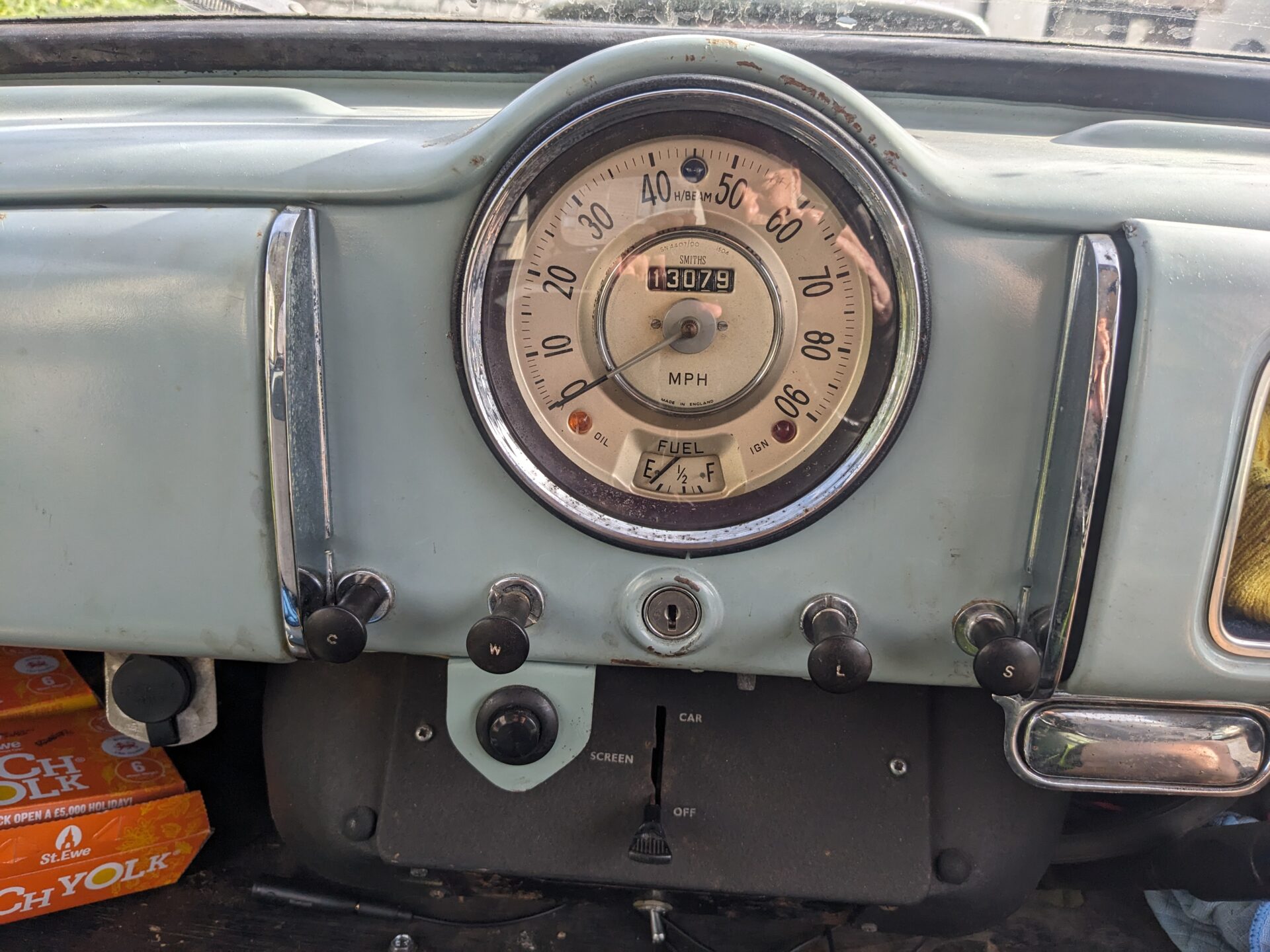

Have you ever noticed that some classic cars seem to straddle two different eras at once? Rosie is a certified “Dual Personality” Morris Minor, registered with the official Dual Personality Register!
What Does “Dual Personality” Actually Mean?
In the world of classic Moggies, a “Dual Personality” (sometimes called a “Split Personality” or “Transitional” car) refers to a specific window of production between September 1962 and October 1964.
During this time, BMC launched the updated 1098cc Morris Minor 1000, but they were notoriously reluctant to throw away perfectly good components already in stock. As a result, cars built during this transition period left the factory as a wonderful hybrid: they received the brand-new, more powerful mechanical upgrades under the bonnet, but retained the charming, older-style interior and trim features from the previous production runs.
It truly is the best of both worlds—you get the improved drivability of the later models, combined with the quaint vintage aesthetic of the earlier ones!
The Upgrades: Tracking the Evolution
To explain this to your followers, it helps to clear up a common misconception about the Morris Minor timeline. The transition wasn’t directly between the historic Series MM (the very early 1948–1953 side-valve models with the low headlamps and split screens) and the 1000. Instead, the Dual Personality cars sit at the tail end of the Morris Minor 1000 era itself, transitioning from the 948cc Minor 1000 to the final 1098cc Minor 1000 upgrade.
Here are the key upgrades made between those two iterations that define a Dual Personality car:
Mechanical Upgrades (The “New” Personality)
- The Engine: The power unit was bumped up from the 948cc A-series to the more robust 1098cc engine, offering better torque and cruising speeds.
- The Gearbox: A stronger, baulk-ring gearbox was introduced to handle the extra power, smoothing out the gear changes.
- Braking Power: The front brake drums were enlarged from 7-inch to 8-inch diameter, vastly improving stopping power.
- Heater: The interior ventilation was upgraded with a larger heating capacity, featuring a small control flap at the bottom of the heater unit.
Retained Vintage Features (The “Old” Personality)
Depending on exactly which month between 1962 and 1964 the car was built, a DP Minor kept several classic features:
- The Dashboard & Controls: It retained the classic central speedometer (calibrated up to 90mph in silver or gold) and the traditional push/pull switches rather than the later toggle switches.
- The Steering Wheel: The iconic 3-spoke wire “banjo” steering wheel was kept.
- The Gloveboxes: Both gloveboxes remained completely open with removable liners, lacking the later plastic lids.
- Wipers and Lights: Early DP cars kept the classic “clap hands” windscreen wipers and the clever combination trafficator/flashing indicator system where the indicator shared a dual-filament bulb with the front white sidelights.
How to find out what features your Morris Minor has
Decode the Chassis Number
Look at your Minor’s chassis plate (usually found on the bulkhead under the bonnet).
- If her chassis number falls between roughly 1,015,100 and 1,051,384 (built Sept 1962 – Oct 1963), she is an early DP. She should have the “clap hands” wipers and the single-unit front sidelights that flash white.
- If her chassis number is between 1,051,385 and 1,092,769 (built Oct 1963 – Oct 1964), she is a later DP. By this point, the factory had transitioned to the longer, parallel-motion wipers and the two-tier front indicator units (amber top, clear bottom).
Inspect the Flashing Logic
Test her indicators! On early Dual Personality models, the rear indicator actually flashes the red brake light circuit rather than a separate amber lens. Check if your Minor utilises this setup or if she has the later, separate amber rear indicator lenses.
Check the Boot Stay
Open your Minor’s boot. Does she have the traditional manual, fixed metal rod that you have to clip into place yourself, or does she have the later, spring-assisted automatic balancing support? DP minors often retained the older manual rod system.
Consult the Heritage Certificate
If you want absolute confirmation of her exact build date, original exterior paint colour, interior trim style, and factory-fitted extras, you can order a Certified Copy of a Factory Record from the British Motor Museum at Gaydon. All you need is her chassis number, and they will pull her original log from the BMC archives.


Leave a Reply