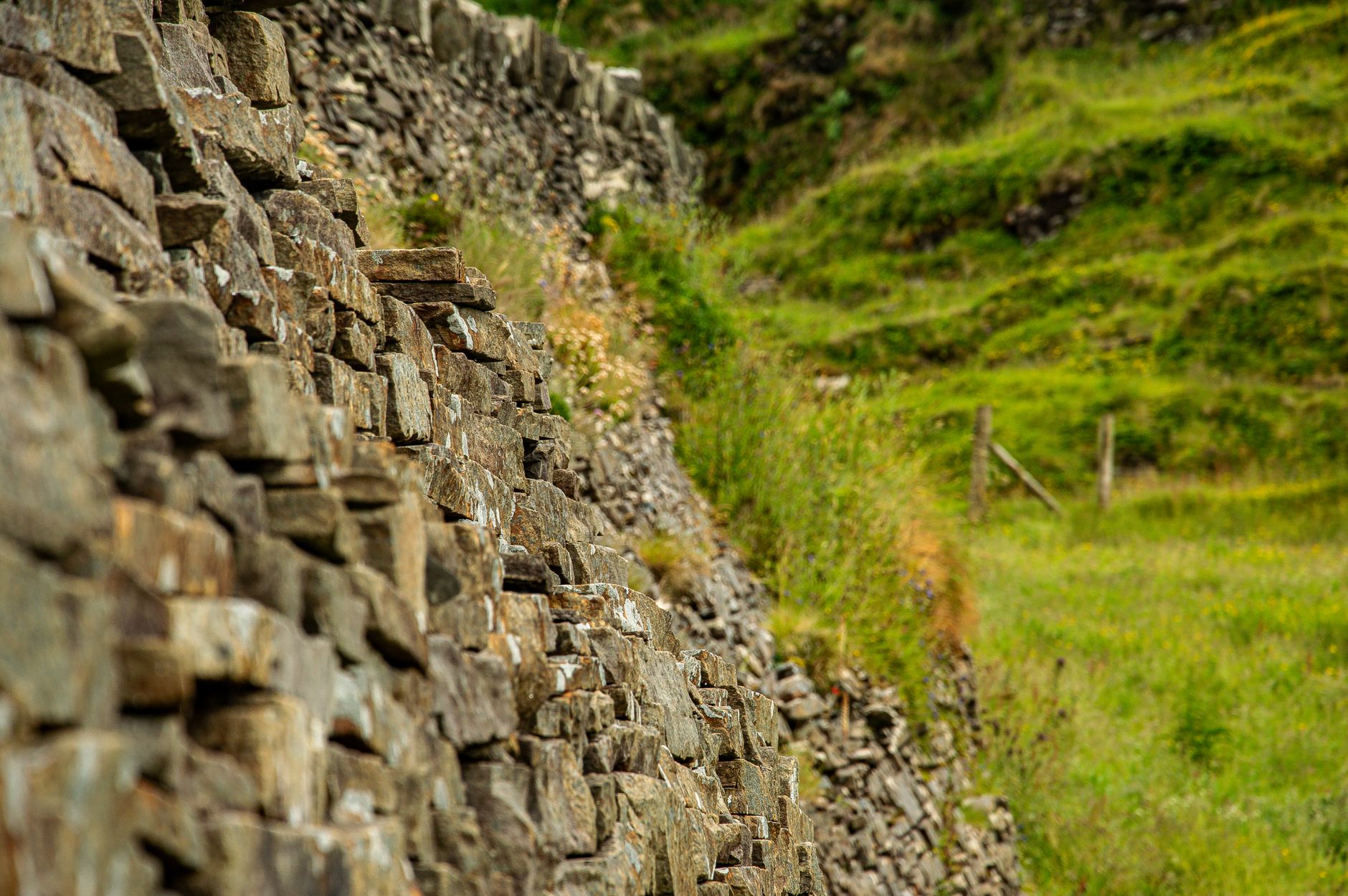
Here is a complete, curriculum-linked 1-hour science lesson plan designed to show teachers exactly how building a Cornish hedge/dry-stone wall delivers core STEM learning in an outdoor setting.
- Target Group: Key Stage 3 / Key Stage 4 (Ages 11–15)
- Subject Area: Science (Physics: Forces, Stability & Gravity | Biology: Microhabitats & Biodiversity)
- Duration: 60 Minutes
- Location: Outdoor Farm / Woodland Site
1. Curriculum Links & Learning Objectives
National Curriculum Focus
- Physics: Balanced forces, gravity, friction, centre of mass, and structural stability without bonding agents (mortar).
- Biology / Ecology: Interdependence, microclimates, habitat niches, and biodiversity corridors.
Learning Objectives
By the end of the lesson, students will be able to:
- Explain how opposing forces, friction, and gravity keep a dry-stone wall standing without mortar.
- Identify why a battered profile (wider base, inward lean) lowers the centre of mass.
- Predict how the stone structure creates distinct microclimates that support local woodland biodiversity.
2. Equipment & Preparation
- Selection of building stones (assorted sizes: large foundation stones, medium face stones, small hearting/infill gravel/stones)
- Tape measures / rulers
- Spirit levels and a batter frame (or simple string lines)
- Work gloves and sturdy footwear for all participants
- Clipboards with simple observation sheets
3. Lesson Breakdown (60 Minutes)
| Time | Phase | Focus & Student Activity |
| 00 – 10 min | Engage & Observe | The Engineering Riddle: Inspect a section of ground or existing wall. Question: “Why does a 200-year-old Cornish hedge stay up without a single drop of cement?” Introduce key forces (Gravity pulling down, Normal contact force pushing back, Friction resisting shear movement). |
| 10 – 25 min | Hands-On Physics | Mini-Experiments in Stability: • Centre of Mass: Pupils test small stacks of stone. Why does placing heavy stones low down make the structure stable? • Friction & Interlocking: Test rounded stones vs angular stones on an incline to see which slips first. • The “Batter”: Demonstrate why wall faces lean inward toward the core. |
| 25 – 45 min | The Practical Build | Applying the Science: Pupils work in supervised small groups to sort and place a course of stone: 1. Foundation: Largest stones set flat to distribute weight. 2. Face & Hearting: Placing stones “one over two, two over one” and packing the core tightly to maximise internal friction and eliminate shear planes. |
| 45 – 55 min | The Ecological Niche | Microhabitats & Biology Link: Examine the gaps between stones. • Identify North vs South facing thermal differences. • Discuss how cool, damp inner crevices act as winter refuges for amphibians (toads, newts) and insects, while sunny exterior faces support lichens and pollinators. |
| 55 – 60 min | Plenary & Review | Quick-fire recap on the three key scientific principles: Friction, Gravity/Centre of Mass, and Ecosystem service. |
4. Key Scientific Principles to Highlight for Teachers
1. Pressure and Weight Distribution
By using wide, flat stones at the base, the gravitational force (weight) is spread over a larger surface area, reducing ground pressure and preventing uneven sinking.
2. Centre of Mass and Structural Batter
A Cornish hedge tapers towards the top. This keeps the centre of mass low and central, ensuring the line of action of weight always falls within the base of the wall, preventing tipping.
3. Frictional Resistance
Without mortar, walls rely on surface friction between rough, angular stones. Internal “hearting” (packing stones) prevents individual face stones from shifting under lateral soil pressure.
5. Easy Extension / Cross-Curricular Ideas
- Maths: Calculate the cross-sectional area, volume of stone required, or measure batter angles using basic trigonometry.
- Ecology Survey: Return in 3–6 months with quadrats or temperature probes to measure plant colonisation (mosses, ferns) and temperature gradients between the sunny and shaded sides.


Leave a Reply